Terroir
Boltshauser Architekten & Garbizu Collar Architecture
Entorno Iglesia de Santiago
2026
TERROIR begins from a simple intuition: that earth is not only the ground beneath the landscape, but also a form of memory, climate, and identity. In wine-growing territories, soil does not merely support the vines; it shapes the character of the place, its rhythms, its resources, and the ways in which it has been inhabited and built over time. Earth already contains a possible architecture.
The project opens a line of research into rammed earth as a contemporary construction alternative in Spain. Rather than reviving a vernacular technique out of nostalgia, it asks how a deeply rooted material logic can be updated through precision, prefabrication, material circularity, and new forms of assembly. The aim is not to reproduce an image of tradition, but to reactivate a system capable of responding coherently to climate, local resources, and the material intelligence of place.
In TERROIR, architecture is understood much like wine understands terroir: as the inseparable result of soil, climate, time, and human knowledge. Earth becomes an active matter that shapes atmosphere and comfort. Its mass stores temperature, regulates humidity, softens extremes, and creates quieter, denser, healthier spaces. It also embodies a contemporary logic of km0 and territorial coherence: building with what the site already contains, with low embodied energy and minimal waste.
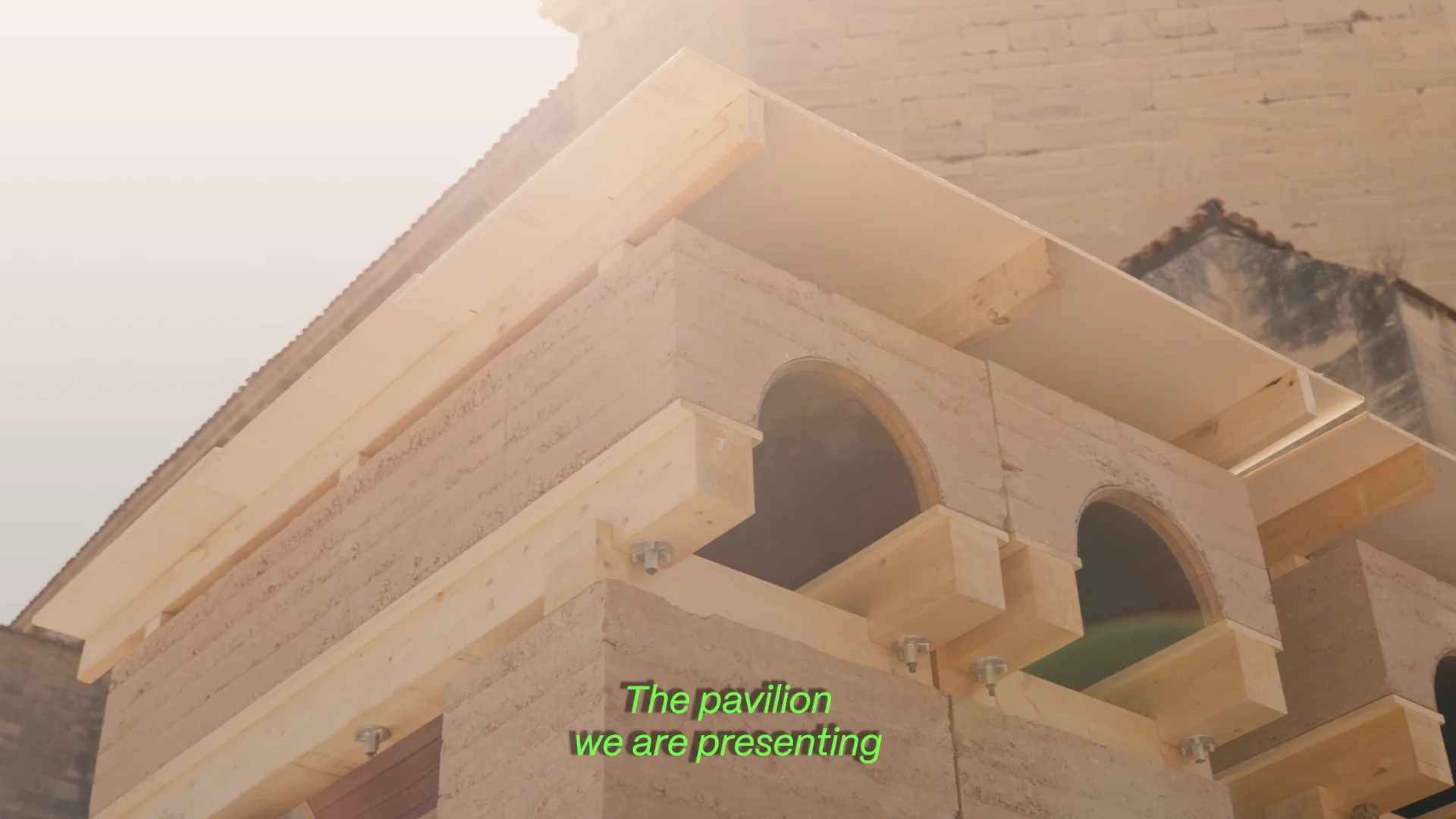
For Concéntrico 2026, this research takes the form of a circular full-scale prototype built from rammed earth and reused wine barrels. The pavilion is conceived as a Climatic Tasting Chamber: a space where wine is not experienced under neutral conditions, but within the same environmental variables that give rise to it. Rather than relying on simulation, the building’s own mass and orientation produce real gradients of temperature, humidity, light, and shade. Reused wood and rammed earth turn terroir into a direct bodily experience.
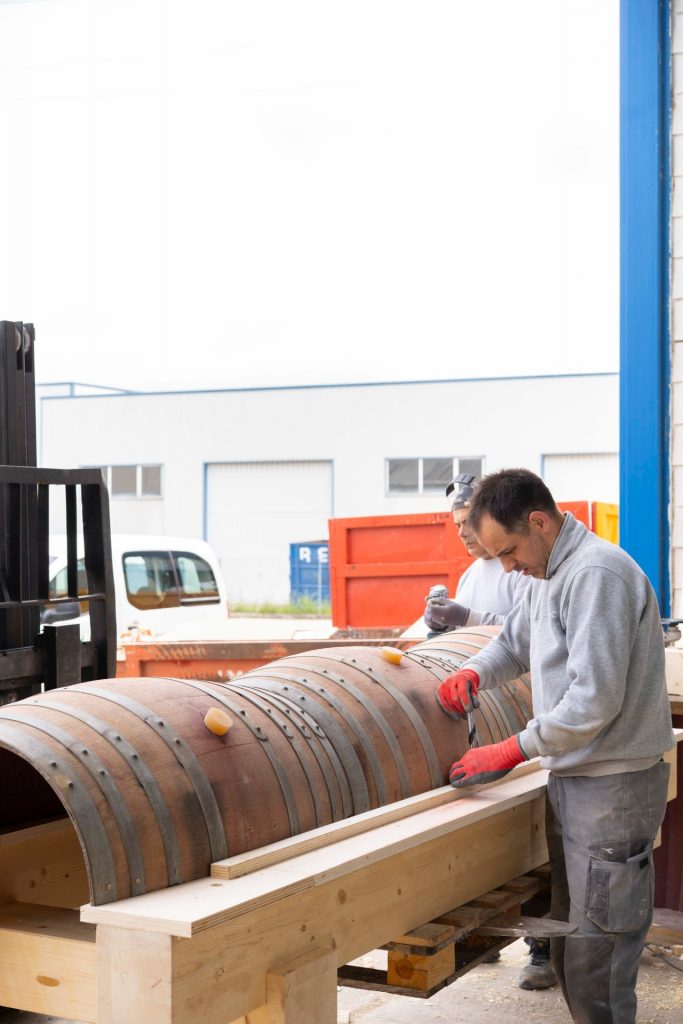
At the center of the construction is a circular and extensible system. The barrels, once their enological cycle is complete, are reused first as formwork for the rammed-earth walls and later as structural support for the roof, becoming fully integrated into the architecture. Earth from local excavation is rammed layer by layer, forming modular elements that are prefabricated and assembled on site.
The earth mixes used come from locally reused excavation material and have been studied and optimized within the project’s own research process. A central theme is the selective stabilization of the earth: in a full-scale experimental setup, the rammed-earth elements are stabilized from bottom to top with decreasing proportions of lime. This allows parameters such as compressive strength and durability to be adjusted in a differentiated way. While the lower zones provide greater structural capacity, the upper wall and roof elements are deliberately left unstabilized in order to maximize the ecological sustainability of the system.
A key and deliberately radical aspect of TERROIR lies in the way it challenges one of the most persistent assumptions around earth construction: that rammed earth must necessarily be cast in situ, immobile, and resistant to industrialized processes. TERROIR proposes the opposite. For Concéntrico, rammed earth is developed as a prefabricated, modular, and demountable system — assembled on site, designed for disassembly, and open to future relocation or extension. In this sense, the pavilion operates within a productive tension between the temporary and the durable: an ephemeral installation that tests a system intended for permanence; a reversible construction that does not renounce mass, inertia, or long-term spatial quality.
The result is a compact pavilion with vertically articulated wall bodies and arched openings, where construction remains visible and the fabrication process becomes legible. TERROIR is therefore more than a temporary installation: it is a built prototype and a demonstrator, showing how rammed earth can evolve into a precise, contemporary, and future-oriented building system. Through the Climatic Tasting Chamber, that research becomes spatial, environmental, and cultural at once.




Boltshauser Architekten & Garbizu Collar Architecture
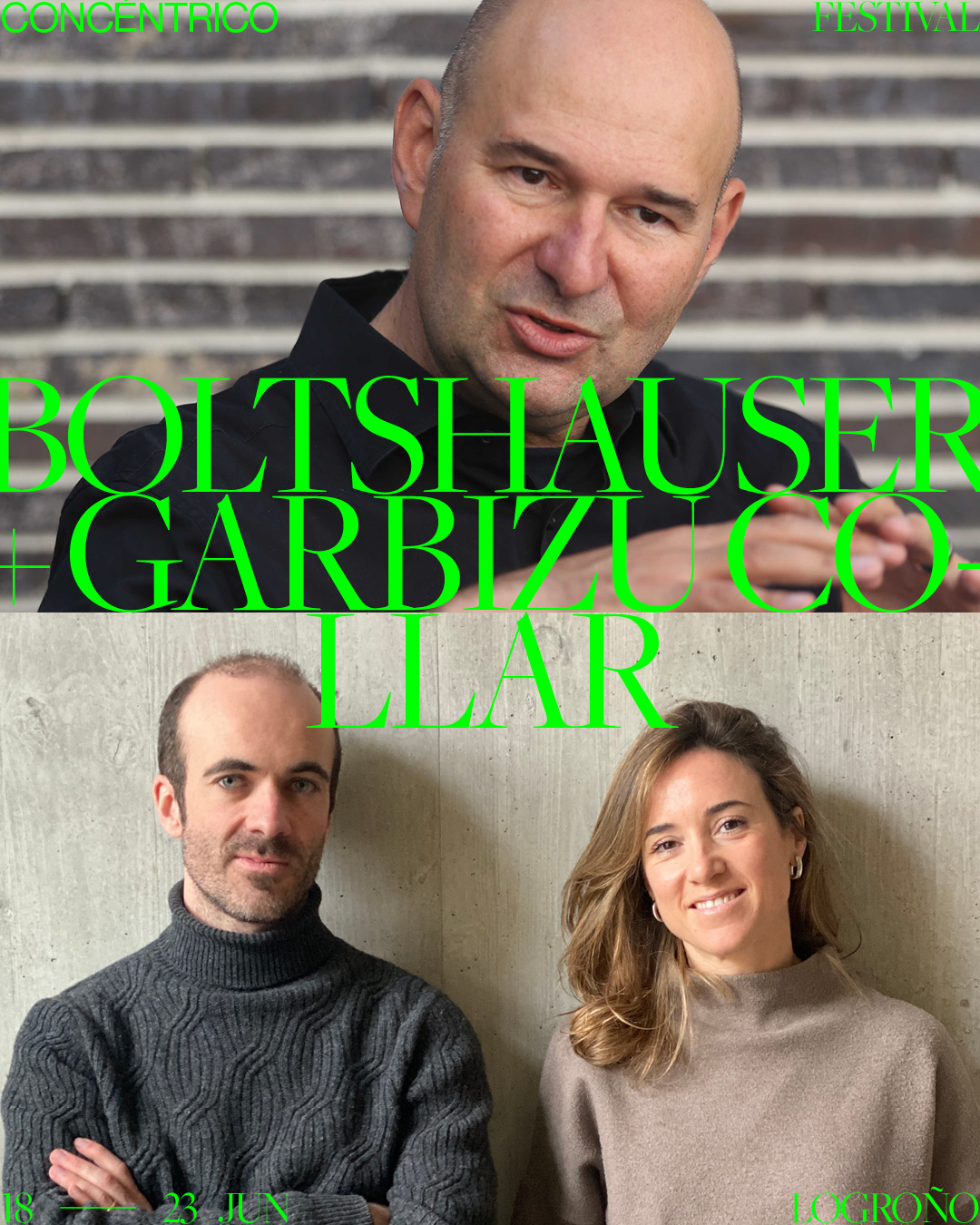
Boltshauser Architekten & Garbizu Collar Architecture brings together two practices that share an architectural research attentive to materials, context and natural systems. Roger Boltshauser’s work is distinguished by its material focus, with particular attention to earthen construction, circularity and the regenerative potential of natural materials —a line he also develops in his teaching at ETH Zurich. Garbizu Collar Architecture, led by Jon Garbizu and Victoria Collar between Switzerland and Spain, combines design, research and curatorship through spatial interventions, exhibitions and applied studies, fostering a sustainable architecture born of the dialogue between culture, territory and matter.
With the support of
